


Glass Pool Fencing Ideas for Modern Family Backyards
April 28, 2026

Creating a safe pool area that still feels open, stylish and welcoming remains a priority for many modern families. With Lake Macquarie Fencing, a backyard pool can be transformed into a feature that looks as good as it performs, particularly when considering pool fencing in Newcastle and surrounding coastal areas where durability and design both matter. This article explores how glass pool fencing supports clear sightlines for supervision, improves spatial flow and delivers a clean contemporary finish, while also outlining how the right glass style, hardware and layout enhance safety and everyday family living.
Glass pool fencing has become a preferred choice for contemporary family homes because it combines safety, style and practicality in one solution. It delivers clear visibility around the pool, a clean, minimalist look and a durable barrier that complies with NSW pool safety standards when installed correctly. In modern family backyards, where space is valuable and outdoor areas are used for entertaining and everyday play, glass fencing helps the pool feel integrated with the rest of the yard instead of being boxed off.
Families often prioritise clear sightlines to the pool so children can be supervised from multiple points in the yard or from inside the home. Glass pool fencing provides an unobstructed view through the panels, making it easier to monitor swimmers and notice if someone has entered the pool area unexpectedly.
This visibility also reduces blind spots created by solid fencing materials. Parents can keep an eye on the water from outdoor dining spaces, decks or kitchen windows without constantly moving position. Combined with compliant self-closing and self-latching gates and the correct fence height, glass fencing can help meet safety obligations while still supporting practical day‑to‑day supervision.

Modern family backyards often feature open-plan alfresco spaces, clean lines and a mix of materials such as rendered walls, composite decking and large-format pavers. Glass pool fencing fits easily into this style because it has a minimal visual footprint and does not compete with other design elements.
Frameless glass with discreet stainless steel spigots offers a sleek, almost invisible barrier that lets paving, landscaping and pool tiling remain the visual focus. Semi-frameless systems with slim aluminium posts still provide a refined look that complements modern facades and outdoor furniture. In smaller blocks, glass fencing can make the yard feel larger because it allows the eye to travel across the entire space instead of stopping at a solid fence.
Pool areas in family homes are rarely used only for swimming. They double as play zones, entertaining areas and quiet spaces. Glass fencing supports this versatility in several practical ways. The smooth, toughened glass surface is easy to clean with glass cleaner or mild detergent and a soft cloth, which suits busy households that do not have time for intensive maintenance.
Because the fence is transparent, it also maximises natural light on adjacent patios and indoor living areas. This helps reduce dark spots around the pool and makes it more inviting to use the space throughout the day. By defining the pool area without blocking movement of light or views, glass fencing allows a modern family backyard to feel open, connected and safe at the same time.
Frameless and semi-frameless glass pool fencing both deliver a clean contemporary look, yet they suit different backyard budgets and maintenance expectations. Understanding how each style works and what it looks like on the ground is essential before committing to a design around a family pool.
Both options must meet Australian pool safety standards, so the decision is less about safety and more about appearance, hardware visibility and how the fence will cope with kids, pets and everyday coastal conditions.
Frameless glass fencing uses thick, toughened glass panels with minimal visible hardware, so the pool almost appears barrier-free. Panels are usually mounted in small metal spigots fixed to concrete, tiled or paved areas. From most angles, only the glass is noticeable, keeping sightlines open from the house to the water and across Lake Macquarie or garden views.
This style suits modern homes with large sliding doors, open decks and contemporary landscaping. It works well where supervision is a priority, since there are fewer posts to interrupt the view of children in the water or on the pool steps. For narrow yards or courtyard pools, frameless panels help avoid a boxed-in feel and allow more natural light through.
Hardware choice has a strong impact on the finished look. Square or round spigots can be used in polished stainless or matte black for a bolder architectural line. For a very sleek result, base channel systems recess the glass into the paving so the support is almost invisible, although this usually requires more preparation during construction.
Frameless systems rely heavily on precise installation. Panels must be perfectly aligned so hinges and latches work smoothly and to prevent any movement in strong coastal winds. Thicker glass and premium hardware usually increase the upfront cost but reduce visual clutter and can add a high-end feel that complements renovated or newly built homes.
Semi-frameless fencing uses glass panels held between vertical posts, which can be aluminium or stainless steel. There is still no top or bottom rail, so the glass remains the main feature, yet the posts create a defined rhythm around the pool and introduce a clear structural frame.
This style often suits busy family backyards where durability and budget are important. Posts provide extra support, so glass thickness can sometimes be reduced compared with fully frameless, which may help control costs on larger pool enclosures. The added structure can also be reassuring, where children regularly push against panels or kick balls around the yard.
Visual impact depends on the post design. Slim rectangular aluminium posts in black or charcoal create a crisp line that pairs well with Colorbond fencing, rendered walls and composite decking. Silver or stainless finishes can match modern balustrades or outdoor kitchens. Post spacing typically ranges around 1 to 1.5 metres, so planning should consider gate positions, corners and how the layout intersects with existing retaining walls or garden beds.
Selection often comes down to how prominent the fence should appear. Frameless suits situations where an almost invisible barrier and uninterrupted views are top priorities, particularly near the water or on upper-level terraces. Semi-frameless suits family spaces that need a strong visual frame, clearer boundaries and a more cost-effective solution without sacrificing a modern look.
In both cases, tempered safety glass-compliant latches and self-closing gates are essential and hardware should be chosen with local coastal conditions in mind to reduce corrosion and maintenance.
A frameless or semi-frameless glass pool fence can make a small backyard feel larger while still meeting safety requirements. The key is to treat the fence as part of the overall landscape design rather than an afterthought, so the yard reads as one connected space instead of a series of boxed-off zones.
Careful placement of the fence line, materials around it and the way access is handled will determine how open the yard feels day to day. Families need clear sightlines to children in the pool, easy circulation for entertaining and enough non-pool space for play and relaxation.
Positioning the glass fence to maintain long views across the block is the first step. Running the fence parallel to the longest boundary helps the eye travel from the house through to the back fence, so the space feels extended instead of chopped in half.
Aligning the pool and fence with existing doors or main windows also matters. When the main living area looks directly across glass fencing to the water, the yard appears like one large outdoor room. Avoid creating narrow, fenced corridors between the house and pool. If setbacks allow, pull the pool and glass line away from the house to create a usable strip of lawn or deck that doubles as a circulation path.
Corners can be softened with angled glass panels rather than tight right angles. This creates a more fluid perimeter and prevents visual bottlenecks where several lines of fencing and building edges meet.
An open-looking backyard still needs clear functions. Positioning the glass gate on the most direct path from the house to the shallow end of the pool helps adults supervise and shortens wet foot traffic through the yard. If there is a barbeque or outdoor kitchen, consider a second gate aligned with that area so food and drinks can move in and out without cross traffic through play spaces.
Outside the fence, create a practical buffer zone for non-pool activities. A strip of flat turf for ball games or a shaded seating area close enough for supervision but outside the wet zone keeps the rest of the backyard usable when the pool is quiet. Planting should be low and set back slightly from the glass so sightlines remain clear and cleaning access is not blocked while still providing softness around the fence line.
Glass fencing keeps sightlines open, which is ideal for supervising kids, but it also makes privacy and sun control more of a design challenge. The key is to treat the fence as one part of a wider pool zone that balances safety, privacy and comfort without compromising the clean modern look. In a family backyard, the most effective approach is to combine the transparency of glass with smart planting, screens and shade structures placed outside the fenced area so that pool compliance and maintenance remain simple.
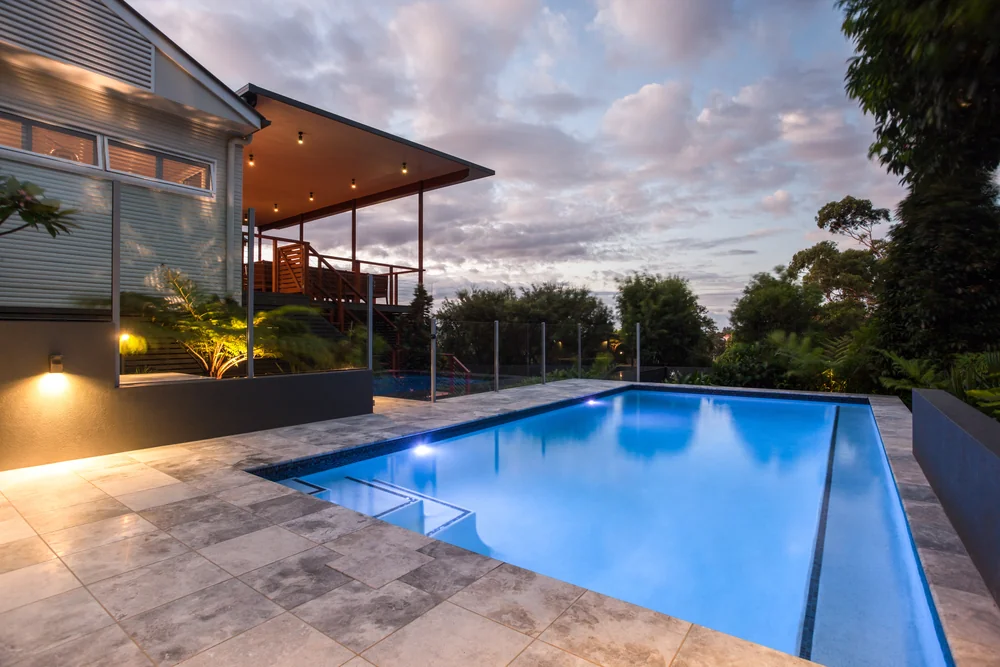
Clear glass offers minimal visual privacy on its own, so additional elements are usually required where neighbours or streets overlook the pool.
For boundary sides exposed to neighbouring windows or decks, privacy can be increased with frosted or tinted glass panels in select locations, particularly along the most overlooked sections. Using frosted glass only on the lower half of panels keeps privacy at seated and shallow-water levels while preserving views to the garden and lake or bush outlooks.
Where full privacy is needed outside the fence, it's the best place for solid screening. Timber battens, aluminium slat screens or masonry feature walls positioned just beyond the glass line give a modern backdrop while leaving the pool fence clean and frameless. Screens can be staggered to block specific sightlines rather than enclosing the entire space.
Glass works best when it feels visually embedded in the garden rather than floating in a hard-paved area. Planting should be planned with the fence layout to avoid constant cleaning and compliance issues.
Low planting along the outside of the fence softens the glass line and hides base spigots while keeping panels clear of foliage. Taller screening plants like clumping bamboo (non-invasive varieties), lilly pilly hedges or pleached trees should be kept a minimum of 600 mm from the glass to reduce leaf litter and avoid branches knocking panels in high winds.
Inside the fenced zone, planting must respect non-climbable zones around the barrier. Use pots with compact plants in corners or against house walls rather than along the fence itself. Select species with minimal leaf drop to reduce time spent vacuuming the pool and wiping glass in coastal breezes.
Glass intensifies reflected light, so shade strategy is critical for child-friendly comfort and to protect the pool surround from excessive heat.
Fixed shade structures work well when located just outside the fenced area with openings aligned so parents can sit in shade while maintaining clear sightlines through the glass. In smaller yards, a cantilever umbrella placed outside the pool fence can throw shade over shallow ends or seating ledges without introducing posts within the pool zone.
Shade trees placed beyond the fence are ideal for different conditions, but species choice is crucial. Choose deep-rooted non-invasive trees with controlled canopy spread and moderate leaf drop and position them so the afternoon summer sun is filtered while the winter sun can still reach the water.
For paved surrounds, consider lighter-coloured non-glare materials to reduce heat build-up reflected through the glass. Combining thoughtful shade with privacy and coordinated planting produces a pool area that feels calm and secluded yet remains highly functional for family use.
Lighting and small design details determine whether a glass pool fence feels like a premium feature or an afterthought. The right approach makes the glass almost disappear at night, highlights the water and keeps sightlines to kids clear while still meeting safety requirements. In coastal conditions, every fitting, finish and fixture also needs to cope with salt air and occasional strong winds. Choosing the correct products at the planning stage prevents corrosion stains on glass panels and avoids expensive retrofits later.
Pool fencing near water needs lighting that is subtle, safe and glare-free. Instead of bright floodlights that reflect off the glass and obscure views, indirect and low-level lighting works best.
LED strip lighting can be recessed into the pool coping or the top of a boundary wall to wash light across the surface and reduce harsh reflections on the glass. Low bollard lights positioned outside the fenced zone define paths and boundaries while keeping fittings away from climbing points that could affect compliance.
For frameless systems, in-ground uplights set just outside the glass line can create a floating effect at night. Careful positioning is critical so beams do not shine directly into swimmers’ eyes or into neighbouring properties. Warm white temperatures around 2700K to 3000K suit family backyards and avoid the harsh bluish tint that can make glass look clinical.
All outdoor lighting within the pool area should be low-voltage and rated for exterior use. With the local climate in mind, marine-grade stainless fixtures or powder-coated aluminium helps resist corrosion from sea breeze and airborne salt.
In contemporary homes, square or rectangular stainless steel spigots in a brushed finish pair well with modern render and large-format pavers. For coastal or Hamptons-inspired properties, soft satin or white powder-coated hardware blends with lighter decking and pale stone.
Where nearby balustrades, boundary fences or outdoor kitchens include metalwork, matching the colour and finish of pool fence hardware gives a coherent result. Gunmetal or matte black fixtures work effectively with darker window frames and charcoal tiles, while classic polished stainless suits lighter palettes.
All fixings should be specifically rated for pool zones with high-grade stainless or properly applied powder coating. Inferior hardware can tea stain or rust, which then leaches onto the glass and paving and requires ongoing maintenance.
Glass pool fencing is a premium feature and a safety requirement, so the decisions made before installation have a lasting impact on cost, compliance and day‑to‑day use. Careful planning helps avoid expensive changes later and ensures the fence suits both the pool layout and the way a family actually lives in the backyard.
From council approvals to the way gates open and close, each detail affects safety, maintenance and the overall look of the space. The following factors should be reviewed before any work begins.
Pool fencing must comply with the Swimming Pools Act 1992 and the relevant Australian Standards. Before installation, it is essential to confirm that the proposed design meets:
Checking requirements with Lake Macquarie City Council or a private certifier before ordering materials prevents costly redesigns and failed inspections.
The existing pool area, soil and surrounding structures dictate what style of glass fencing will work best. Frameless glass looks clean and unobtrusive but relies on strong footings for spigots. Semi‑frameless systems may suit areas with more movement in the soil or where there is an existing concrete slab.
Surface type is critical. On pavers or older concrete, it may be necessary to reinforce or repair sections so the fence remains secure over time. Around waterfront or exposed locations, wind loading must be considered so panels and hardware are specified to cope with stronger gusts.
Glass pool fencing ranges widely in price depending on panel thickness, hardware quality and the complexity of the layout. Curved sections, custom‑cut glass or extensive core drilling will increase costs. It is sensible to prioritise safety and hardware quality, then tailor other features to the available budget.
Low‑iron or “ultra-clear” glass provides a more transparent look around water views but comes at a premium. Standard clear toughened glass is more cost‑effective and still delivers a modern aesthetic. For busy family pools, nano‑coatings can reduce water spotting and make cleaning faster.
Visually, the fence should complement existing finishes. Brushed stainless or matte black spigots and posts suit many contemporary homes, while polished fittings create a more luxurious look. Planning how the fence aligns with decking boards, coping lines and garden beds helps the new barrier feel integrated rather than an afterthought.
In a modern family backyard, glass pool fencing serves as more than a safety requirement. It becomes a defining design element that shapes how outdoor spaces are used for entertaining, relaxation and daily routines. From frameless installations that visually blend into the landscape to semi-frameless systems that balance cost, durability and structure, the right solution protects children and pets while maintaining openness and connection across the yard. When combined with compliant heights, high-quality hardware, well-planned gate placement and thoughtful integration with decking, lighting and landscaping, the result is a pool zone that feels cohesive, functional and refined.