


How to Choose Glass Pool Fence Hardware for Coastal Homes
June 25, 2026

Choosing the right hardware is one of the most important decisions when installing glass fencing in Newcastle, particularly in coastal environments where salt, moisture and strong winds can accelerate wear. Lake Macquarie Fencing understands that durable, high-quality hardware is essential for maintaining the safety, appearance and performance of a glass pool fence.
For coastal glass pool fencing, hardware selection should be based on more than appearance. Spigots, fixings, hinges, latches and anchors all need to be suited to marine conditions, the installation surface and NSW pool safety requirements. In many coastal settings, 316 marine-grade stainless steel is considered a minimum, while 2205 duplex stainless steel may be preferred for highly exposed locations.
This article explains how coastal conditions affect fence hardware, which materials and finishes are better suited to marine environments, and what to consider when selecting spigots, fixings, hinges, latches and other components. It also outlines the importance of compliance, correct installation methods and hardware designed to withstand harsh coastal conditions.
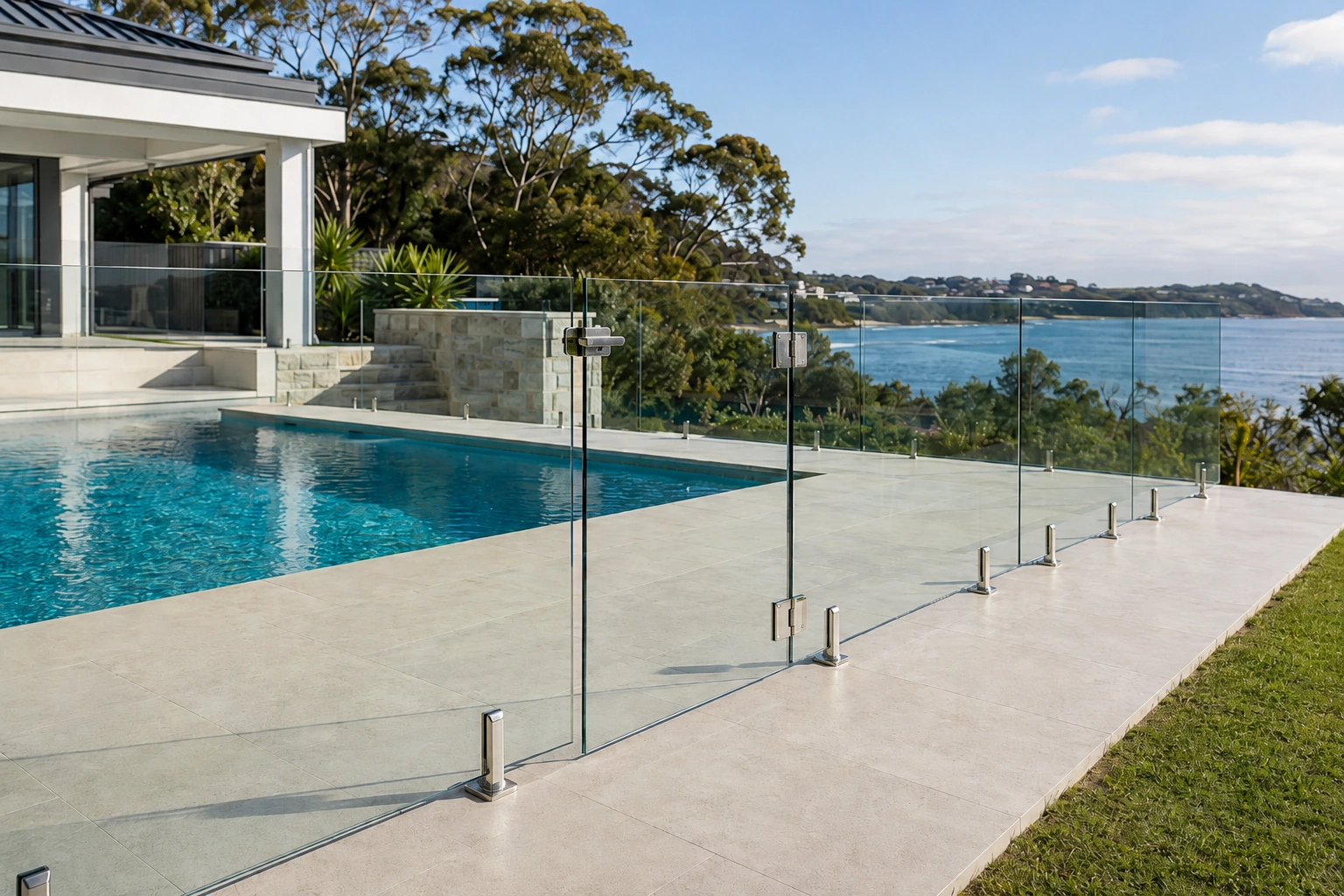
Coastal homes face harsher conditions than inland properties, which can directly affect how long glass pool fence hardware lasts and how safely it performs. Salt in the air, constant moisture, strong UV exposure and wind-driven rain can accelerate wear on metal fixings, glass fittings and gate components.
Choosing unsuitable hardware can lead to corrosion, stiff or sagging gates, loose fittings and premature component failure. Understanding these environmental pressures explains why standard pool fencing hardware that performs adequately in suburban settings can deteriorate more quickly near the coast. Materials, finishes and fixing methods need to be matched to the site conditions rather than chosen on appearance alone.
Sea spray and prevailing coastal winds carry fine salt particles that settle on exposed surfaces. When combined with moisture from humidity, rain or pool splash, this creates an aggressive corrosive environment for metal hardware.
Mild steel and low-grade stainless steel can show visible rust within a short period in these conditions. Corrosion rarely stays cosmetic once it begins. It can cause pitting in spigots and brackets, reduce the structural thickness of components and seize moving parts such as hinges and latches.
Even stainless steel is not immune. Lower grades, such as 304 stainless steel, may perform acceptably in inland areas but are more prone to tea staining and pitting near the coast, especially on flat or horizontal surfaces such as base plates and channel systems. For glass pool fencing in coastal zones, corrosion resistance is a safety consideration as well as an appearance issue, because compromised hardware can affect panel stability and gate operation.
Pool areas add constant moisture to an already damp coastal environment. Hardware is repeatedly exposed to chlorinated water or saltwater splash, overnight condensation, rainfall and cleaning products. This continual wetting and drying cycle can accelerate corrosion and affect non-metal components.
Rubber gaskets and plastic parts can harden or degrade more quickly when exposed to pool chemicals, UV and salt. Over time, this may reduce the grip on glass panels or affect the alignment of gates and latches.
Moisture can also become trapped where glass meets metal, under cover plates or inside poorly drained channels. If the hardware or fixings are not designed to shed water, corrosion can start unseen and only become obvious once more serious damage has occurred.
Coastal areas often experience stronger and more frequent winds, placing additional load on glass panels and fixings. Each gust places stress on spigots, posts, anchors and brackets. If corrosion has already weakened these components, the risk of movement or failure increases.
Gate hardware is also affected by constant use and wind pressure. Hinges and self-closing mechanisms must work reliably even when the gate is exposed to changing wind conditions. In cheaper or unsuitable products, springs and pivot pins may wear faster, while minor corrosion can quickly interfere with smooth closing and self-latching performance.
Strong UV exposure around open coastal pools can also accelerate the breakdown of plastics, powder-coated finishes and lubricants used within latches and hinges. Faded coatings or brittle plastics are not only visual issues. They can shorten the service life of essential safety components if the products are not designed for high-UV coastal use.
Salt-laden air and wind-driven moisture attack metal fixtures every day. The wrong spigots and fixings can pit, stain or loosen over time, which not only affects appearance but can also compromise the safety of the fence.
Selecting the correct materials, grades and finishes for spigots, brackets, bolts and anchors is critical. Corrosion resistance should be the first priority in a marine environment, followed closely by structural strength, compatibility with the surface and compliance with pool safety requirements.
Grade 2205 duplex stainless steel is often preferred for highly exposed coastal pool fencing hardware because it provides stronger resistance to pitting and tea staining than standard stainless steel. It is especially suitable for exposed base-plated spigots, face-fix brackets and fittings directly facing water or prevailing coastal winds.
Grade 316 stainless steel is generally the minimum suitable option for many coastal applications. It can perform well when combined with a quality surface finish and regular maintenance, although it may show tea staining sooner than 2205 in harsher locations such as beachfront properties, elevated decks or areas exposed to strong sea breezes.
The finish also matters. Bright mirror-polished finishes generally perform better because the smoother surface is less likely to trap salt and contaminants. Brushed or satin finishes can be more prone to spotting and may need more frequent cleaning in coastal environments.
Spigots are only as durable as the screws, bolts and anchors that hold them in place. Mixing inferior metals with premium spigots can create weak points and may increase the risk of galvanic corrosion.
All external fixings should be stainless steel and compatible with the spigot grade. For most coastal systems, this means 316 or 2205 stainless steel bolts, screws and washers. Zinc-plated or basic galvanised fixings should not be used near pools or coastal areas, as the coating can deteriorate quickly in salt conditions.
For core-drilled spigots installed into concrete or masonry, non-shrink grout or structural epoxy designed for wet areas is important. Cheap cement mixes may crack, allowing water ingress and increasing corrosion risk around the base of the spigot. Plastic sleeves or liners in core holes can provide an additional barrier between the metal and porous concrete while reducing staining.
Where face-fix channels or stand-off pins are installed into masonry, anchors should be stainless steel mechanical anchors or high-spec chemical anchors rated for pool and coastal environments.
Hardware design also affects corrosion resistance and lifespan. Frameless spigots with concealed fixings can reduce the number of exposed edges and crevices where salt can accumulate. Rounded profiles also tend to shed water more effectively than sharp-edged designs.
Drainage should be considered carefully. Base covers or trims that allow water to escape are usually preferable to enclosed designs that trap moisture around the spigot. Moisture trapped beneath covers can accelerate tea staining, especially on tiled, stone or concrete surfaces that remain damp.
When selecting hardware, look for products designed for pool fencing and suitable for coastal or marine environments. Hardware manufacturers should provide product data, installation guidance and clear information about where their products can be used.

The right fixing method depends on what the glass fence is being anchored to. In coastal locations, wind load, salt exposure, drainage and surface movement make that decision even more important. Choosing hardware that suits both the surface material and the site conditions is essential for a fence that remains rigid, secure and compliant.
Each surface has different requirements for fixing type, embedment depth, waterproofing and preparation. Matching spigots, posts or channels to the base material helps reduce corrosion, movement and water ingress into decks, slabs or masonry.
Concrete is generally one of the most stable bases for glass pool fencing if the correct anchoring method is used. For frameless glass, spigots are commonly core-drilled into the slab or fixed with heavy-duty mechanical anchors.
Core drilling involves cutting holes into the concrete, setting the spigots in high-strength non-shrink grout, then sealing the top to reduce water tracking into the slab. This method spreads the load into the slab and can be suitable for higher wind exposure near the lake or coastline when designed and installed correctly.
Surface-fixed spigots or posts require appropriate stainless steel anchors with sufficient edge distance and embedment depth. On tiled slabs, fixings must penetrate through the tiles into structural concrete, not just the tile bed. Penetrations should be neatly cored to avoid cracked tiles, then carefully sealed with a UV-stable flexible sealant to help keep water out of the substrate.
Timber decks need careful assessment because standard decking boards cannot support a pool fence on their own. Fixings must anchor into the underlying joists or into dedicated structural blocking installed where each spigot or post will sit.
On coastal decks, frameless glass is usually installed using base-plated spigots or mini posts that bolt through to solid framing with stainless steel coach screws or through bolts. If the existing deck framing is too light, it should be upgraded before installation to reduce flexing, panel rattle and gate misalignment.
Waterproofing around fixings is critical. Every penetration should be pre-drilled and sealed to minimise moisture entering the timber. This helps reduce corrosion risk around the fixings and may also help extend the life of the deck structure. Hardware in this setting should be marine-grade stainless steel.
Paved areas and pool coping stones often sit on a sand bed or thin mortar, which is not suitable for structural fixing. In these cases, the fence should usually be set into a concrete beam beneath the pavers or fixed to a nearby concrete edge or retaining wall.
If the fence line runs through soil or lawn, a continuous concrete footing or strip beam is usually needed to carry the glass fence. Spigots can then be core-drilled or bolted into the footing rather than installed directly into the ground.
This approach helps prevent movement as soil settles or becomes waterlogged after coastal rain, while keeping hardware out of constantly damp ground conditions.
Hinges and latches are the moving parts of a glass pool fence and are often the first components to fail if unsuitable products are used. The right gate hardware keeps the gate self-closing, self-latching, secure and compliant despite ongoing exposure to salt air, moisture and wind.
In a marine environment, gate hardware must be chosen for corrosion resistance as well as appearance. Material grade, spring strength, latch design and compatibility with the glass panel all influence how reliably the gate performs over time.
For coastal homes, 316 marine-grade stainless steel is generally the minimum suitable choice for hinges and latches. This alloy contains molybdenum, which improves resistance to pitting and tea staining in salt-exposed environments. Where budget allows, 2205 duplex stainless steel may provide higher corrosion resistance and strength for heavier or more exposed gates.
Hardware with zinc plating, basic chrome plating or low-grade metal components is not suitable near the coast, as finishes can blister, flake and rust. Powder-coated stainless steel in black or other colours can add another layer of protection, but the base metal still needs to be suitable for marine conditions.
Aluminium hinges and latches should only be used if they are specifically rated for pool environments and supplied with compatible stainless steel fixings.
Pool gates must self-close and self-latch from any position without assistance. In practice, this depends on the correct combination of hinge type, gate weight, latch design and installation angle.
Quality glass pool gates generally use tensioned spring hinges or soft-close hydraulic hinges. Spring hinges are more economical but rely on correctly set tension and may need occasional adjustment. Hydraulic hinges provide smoother closing and reduce slamming, although they cost more and must be installed according to manufacturer instructions.
The latch must be positioned so the finished gate complies with NSW pool safety requirements. In many cases, the release mechanism needs to be at least 1500 mm above finished ground level on the outside of the gate, unless it is shielded or configured in an approved compliant way. The final position should always be checked against the applicable pool barrier standard and local inspection requirements.
Gate hardware must be compatible with the glass thickness, gate width and panel style. Frameless glass gates generally use clamp-style hinges that grip the glass with compression plates, while semi-frameless systems may hinge from aluminium or steel posts.
Using hinges that are not rated for the glass thickness or gate weight can lead to sagging, misalignment or unreliable closing. The manufacturer’s weight rating should always be checked, and the selected hinges should exceed the actual gate weight rather than only just meet it.
All fixings, including screws, pins and internal components, should be made from stainless steel compatible with the visible hardware. This reduces the risk of corrosion between mixed metals and helps maintain reliable gate operation.
Every piece of glass pool fence hardware needs to support the compliance of the completed barrier, not just the panels and gate. In coastal NSW, even one poorly positioned hinge, latch or spigot can cause problems during inspection if it creates a climb point, affects the gate’s self-closing function or changes the required clearances.
Compliance is not only about choosing products labelled as “pool safe”. Hardware should be selected and installed so the completed barrier complies with Australian Standard AS 1926.1, NSW pool safety requirements and any relevant council inspection requirements.
For a glass pool fence in NSW, the key compliance points that relate directly to hardware selection include:
Hinges and latches must be chosen so these requirements are met after installation. For example, spring-loaded self-closing hinges need enough tension capacity to reliably close a heavy glass gate from any open position. The latch must also be positioned so children cannot easily reach or operate it from outside the pool area.
Only hardware specifically designed and rated for frameless or semi-frameless glass pool fencing should be considered. Product data sheets, installation specifications and written certification can help confirm whether spigots, hinges, latches and fixings are suitable for the intended use.
Local certifiers may request documentation to confirm that the hardware and installation method meet relevant standards. Using generic glass hardware without this information can create issues during inspection, even if the fence appears solid.
Glass gate hardware is particularly important. Soft-close or hydraulic hinges must be rated for the exact glass thickness, gate width and gate weight being used so the closing speed remains consistent and the gate reliably latches. Underspecified hinges can allow a gate to slow, stall or fail to latch properly.
Hardware that complies in theory can still lead to a non-compliant fence if the layout is not designed correctly. Before ordering or installing hardware, the following details should be checked:
Hardware must resist rust, movement and loosening for the life of the fence. Corrosion-resistant anchors, washers, screws and fixings are part of maintaining compliance because structural movement can increase gaps, reduce effective fence height or interfere with gate performance.
Selecting glass pool fence hardware for a coastal property requires more than choosing components that complement the overall design. Corrosion-resistant materials, suitable fixing methods, reliable gate hardware and compliant installation all contribute to a fence that remains safe, secure and visually appealing despite exposure to salt air, moisture, wind and harsh weather.
For properties in Newcastle and surrounding coastal areas, careful planning is especially important. Matching hardware to the site conditions, using marine-grade materials and ensuring the finished barrier meets NSW pool safety requirements can help minimise maintenance, extend hardware lifespan and support reliable long-term performance.